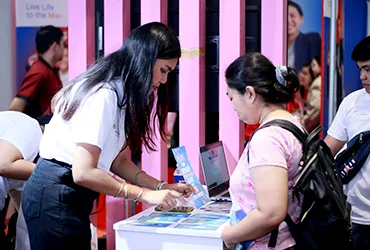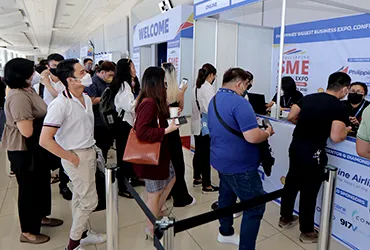
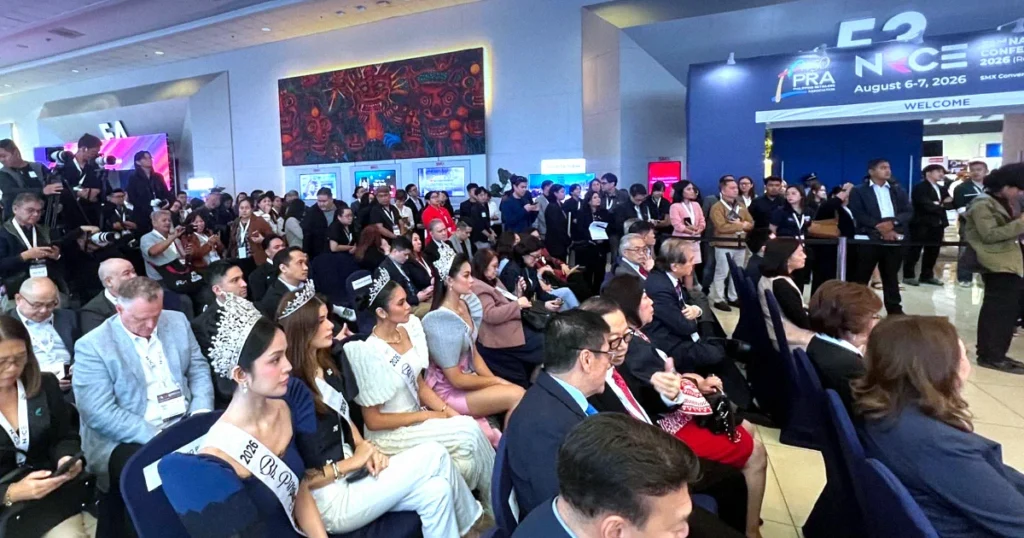
MediaTrix onsite coverage of the 32nd National Retail Conference and Expo (NRCE 2026), SMX Convention Center, Manila, August 6, 2026. MediaTrix Solutions attended the event to support the SME and e-commerce sector.
As part of its commitment to helping Philippine SMEs stay competitive, PHILSME joined the opening day of the 32nd National Retail Conference and Expo (NRCE) 2026 at the SMX Convention Center Manila. The event gathered retail leaders, technology providers, and industry experts who shared practical insights that small and growing businesses can apply as they navigate an increasingly digital marketplace.
Many of the discussions extended beyond large retail enterprises. Sessions on leadership succession, customer experience, and unified commerce offered valuable lessons for SMEs looking to strengthen their operations, embrace innovation, and prepare for sustainable growth.
One message resonated throughout the conference. During his keynote address, Virendra Prakash “VP” Sharma, Founder and Group CEO of MAP Group, remarked:
“You can get strategy for free from ChatGPT or Claude,” Sharma said. “But in our industry, it’s execution that wins.”
It was a single sentence inside a much longer keynote about the slow, collaborative work of scaling a retail business across a region. It was the kind of talk built over decades, not negotiated in a boardroom over a weekend. But by the end of the day, four more sessions had circled back to it, each from a different angle, until it stopped sounding like a keynote soundbite and started sounding like the conference’s actual thesis.
The first return came from Professor Enrique Soriano, ASEAN Family Advisor for Governance and Strategy at Wong + Bernstein Advisory Group, who opened Session 1, “Stepping Back, Moving Forward: The Real Work of Succession,” with six words next-generation leaders would have to earn rather than inherit: credibility, confidence, clarity, consistency, currency, and ability. Titles, he made clear, aren’t on the list.
“Successors are not like the popes,” he said. “The popes can be there perpetually, right? Successors have an SLA. If they don’t hit their KPIs, if their leadership is in question, they can be removed. The next generation cannot step up into a space that is still occupied. And a senior generation cannot step up into a space that has not been defined.”
Soriano in Session 1 showed a slide that would frame everything the next panel went on to demonstrate: “A gate without a date is a wish. A date without a gate is a coronation.” The mechanism, not the intention, is what determines whether a transition actually happens. And a coronation, unlike a succession, asks nothing of the person receiving it.
He then moderated Session 2, “Dynasty in Motion: Next-Generation Leadership in Philippine Retail,” which picked up exactly where his framework left off. Bryan Liu, VP for Strategy and Operations, and Brandon Liu, VP for Penshoppe and OXGN, both of Golden ABC, the group behind Penshoppe, OXGN, Regatta, and ForMe, joined Justine Thai, Manager of Corporate Communications, Strategy, and Planning, and Jathniel Thai, Regional Controller and Strategy Manager, both of Primer Group of Companies — two sets of siblings and cousins from two of the country’s most recognized retail families.
None of the four described inheriting authority. None of them described inheriting the wall coming down. They described taking it apart piece by piece: mandatory years working somewhere else first, small early decisions that had to prove themselves in the numbers before the next one was trusted, governance structures built to replace the informal, undocumented way decisions used to move through the family.
The second return came from Veer Ahuja, Director of Solution Architecture at ETP Group, in a session called “Frictionless Retail: Eliminating the Invisible Walls in Unified Commerce.” He opened with the numbers. The Asia-Pacific region already accounts for more than half of global digital sales. Roughly 80 percent of shoppers across the region are mobile-first. The Philippines leads the region on that metric, with 92 percent mobile-first internet access, 13.8 percent year-on-year e-commerce growth, and a 30 percent jump in omnichannel sales.
Ahuja draws a sharp line between two models: 2010s omnichannel and modern unified commerce. Traditional omnichannel simply stitches separate systems together after the fact, creating fragmented inventories, duplicate profiles, and multiple points of failure. Unified commerce replaces those seams with a single real-time core — one inventory ledger, one customer profile, and a single source of truth across every touchpoint.
He walked the room through two scenes. A customer wants a jacket in a size the store doesn’t carry. Under a unified system, a sales associate checks the network, finds the size two branches away, and has it moving toward the customer, same-day delivery or held for pickup, within twenty seconds. A loyal customer abandons an online cart, then walks into a physical store. Staff can see the abandoned items on the customer’s profile and walk them straight to the shelf, converting browsing intent into an in-person sale before the customer has to ask.
He closed on a line that read almost like a warning label: “The window is open. But it won’t stay open. Your customers are already living in a frictionless world. They shop everywhere, pay anywhere, and expect to be known wherever they go. The only question is, — will your retail experience meet them there, or will the invisible walls send them somewhere else?”
It was, in its way, the most literal illustration of Sharma’s line that the day would produce. E-commerce, in Ahuja’s telling, isn’t a channel bolted onto a retail strategy; it’s where strategy stops being an idea and starts being infrastructure. The gap between a street-level storefront and a screen-level conversion is no longer a question of vision. It’s a question of engineering: inventory ledgers, fulfillment nodes, payment rails, all of it invisible to the customer and all of it, Ahuja argued, the actual site where retailers either execute or don’t.
The day closed with “She Built That: Women Changing the Game in Philippine and Regional Business,” moderated by Marife Zamora, Independent Board Director at SM Investments Corporation, with Mybelle Aragon-GoBio, President and CEO of Robinsons Land Corporation; Mharicar Castillo-Reyes, President and CEO of Asticom; and Mia Egron, Head of Luxury Retail at MAP Group.
Aragon-GoBio, the first female and first non-family CEO in Robinsons Land’s 33-year history, spoke about earning trust through consistency rather than title. Castillo-Reyes described the pandemic-era decision that turned Asticom from a single staffing company into a group spanning BPO operations and engineering services, a transformation, which she said was born out of necessity rather than ambition, when the alternative was watching the business and its people shrink.
It was Egron’s account that gave the panel its sharpest edge. After 27 years with the Plaza Indonesia group, where she became a prominent female and foreign-born executive, serving as President Director and CEO of Plaza Nusantara Realty. She decided to leave a role she described as comfortable, protected, and secure and join MAP Group’s luxury-retail division instead.
“I was very comfortable, well protected, and my shareholders were like my family,” Egron said. “But I said to myself, I’m not going to expect that this is it. I have to say I’m very proud of myself, because it’s not easy to do that. It’s not easy to walk away from something that comfortable, at this age, and try something new.”
Her decision was, in its own register, the same argument Sharma opened the day with. A strategy, even a successful one, even one that worked for decades, is not the same thing as continued execution. At some point, staying inside a system that already works stops being a strategic choice and starts being the absence of one.
None of the four sessions referenced each other directly. But by the end of Day 1, the shape of the conference’s actual argument was hard to miss. Strategy has become a commodity — accessible, replicable, available on demand from any large language model. What will separate the retailers who define the Philippine market’s next decade from the ones who don’t is not the quality of their ideas. It’s whether they’ve built the systems to execute them, the governance to hand them off cleanly, and the willingness to walk away from what already works in order to build what’s next.
Of the four sessions, Ahuja’s was the only one where the argument played out in concrete, operational terms rather than in appeals to conviction or culture. He didn’t ask retailers to commit to unified commerce the way Soriano asked successors to commit to earning their seats, or the way Egron described choosing to leave a comfortable role. He showed what the system does when a customer wants a jacket in the wrong size, or abandons a cart and then walks into a store. Set against Sharma’s opening line, it reads as the day’s most literal answer to the question of what execution actually consists of: not a mindset, but a set of systems that either return the same answer across every channel or don’t. (Krizzia Nieva)
Like NRCE, the Philippine SME Business Expo & Conference (PHILSME) is an annual gathering that brings together entrepreneurs, business owners, and solution providers to support the growth of Philippine enterprises. The 19th PHILSME will be held on May 20–21, 2027, at the SMX Convention Center Manila. Learn more and stay updated through the PHILSME Blog at https://philsme.com/blog/.